
What is a Fractional CFO?
Kevin Hwang
|
August 25, 2026
Key Takeaways:
- A fractional CFO provides senior financial leadership on a part-time or scoped basis, giving a growing company CFO-level judgment before a full-time executive role makes sense.
- Fractional CFO work centers on forecasting, financial strategy, cash and capital planning, and interpreting financial information for decisions such as hiring, pricing, investment, and growth.
- A controller is closer to an accounting operations and reporting discipline, while a fractional CFO uses financial information to help leadership decide what to do next.
- A fractional CFO is often useful around specific business moments, including fundraising, exit preparation, audit preparation, board reporting pressure, or the departure of an internal finance leader.
A fractional CFO is a senior finance leader who works with a business part-time or within an agreed scope, giving leadership CFO-level strategy without requiring a full-time executive hire. For a growing company, the more useful question is often whether the decisions being made have become more complex than the current finance setup can support.
That can happen even when the books are accurate. Leadership may have an income statement and balance sheet in hand and still lack a reliable answer to questions such as: Can cash support another hire? What happens if revenue comes in below plan? Can the company afford bonuses this quarter? Is a pricing change improving margin? A fractional CFO helps connect financial information to those decisions.
What does a fractional CFO do?
A fractional CFO provides senior financial strategy and interpretation, with scope that may include forecasting, fundraising, exit support, and other consequential business decisions. The role usually works closely with the founder, CEO, finance leader, or other executives responsible for deciding where the business goes next.
The U.S. Bureau of Labor Statistics describes financial managers as professionals who create financial reports, direct investment activities, develop plans for long-term financial goals, and advise senior managers on financial decisions. Fractional CFO work applies that senior finance capability through a part-time or outsourced engagement rather than a full-time executive position.
Turn financial information into decisions
The work goes beyond reviewing what happened last month. A fractional CFO helps leadership understand what the numbers mean for the choices in front of the business. That might include evaluating whether a hiring plan fits expected cash, how a pricing change affects margin, or whether an investment can be made without putting other commitments under pressure. The useful output is a better-supported answer to a business question, grounded in the reports and analysis behind it.
Build a forward-looking financial view
Depending on the engagement, the work may include several forward-looking responsibilities:
- Cash forecasting and scenario planning
- Budget and forecast review
- Financial modeling for hiring, compensation, pricing, or investment decisions
- Capital planning and fundraising support
- Board and management reporting
- Financial preparation for an acquisition, sale, or other major transaction
The exact mix should follow the decisions leadership needs help making rather than a generic CFO checklist.
Know where CFO work stops
CFO-level support does not automatically include transaction coding, bank reconciliations, accounts payable, accounts receivable, or the monthly close. A bookkeeper, controller, internal accounting team, or outsourced provider may own those responsibilities.
That distinction matters because senior financial advice depends on dependable financial information underneath it. The BLS description of accountants and auditors helps illustrate the difference between maintaining and examining financial records and the senior planning and decision responsibilities associated with financial management.
Fractional CFO vs. full-time CFO vs. controller
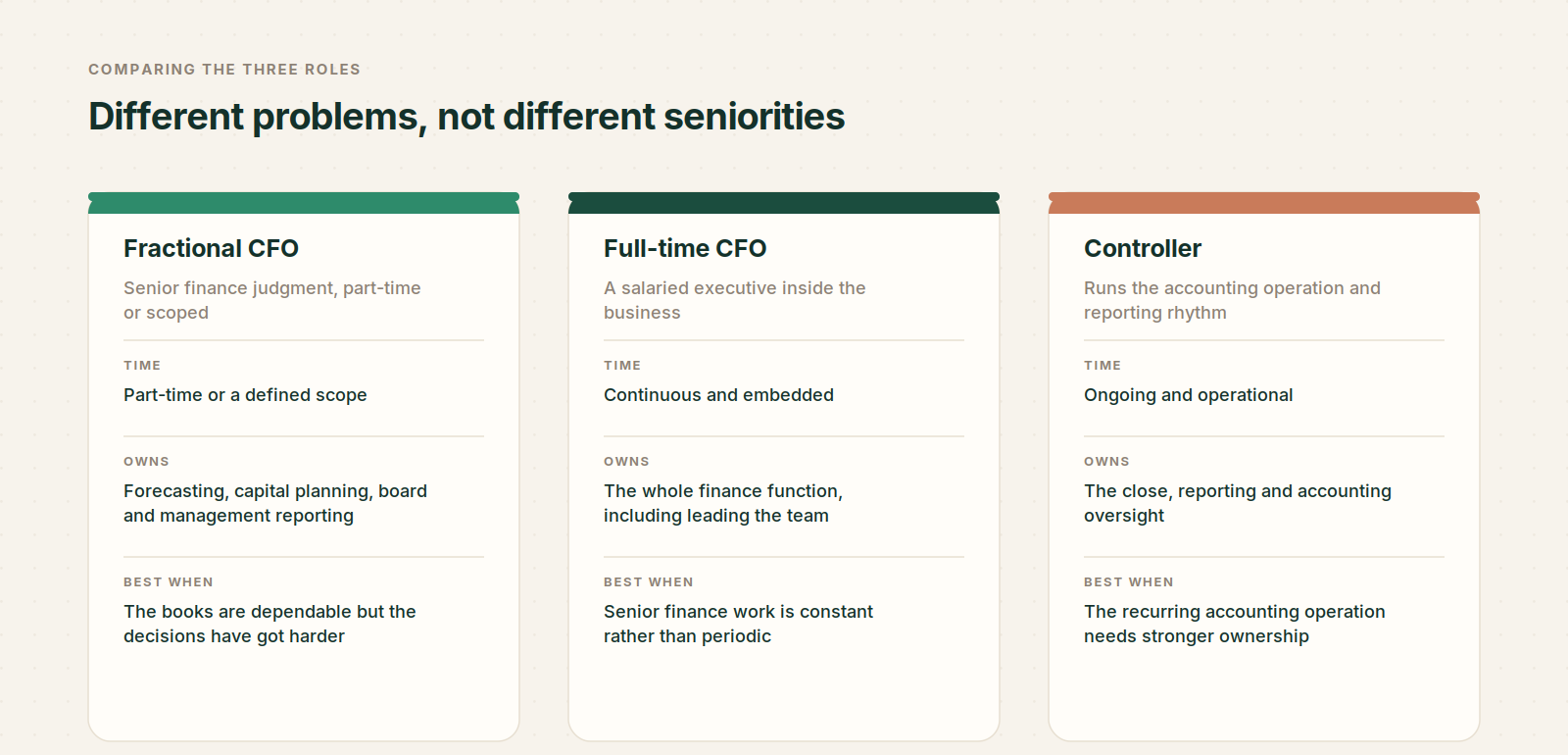
A fractional CFO, full-time CFO, and controller solve different finance-capacity problems. The right choice depends on whether the business primarily needs senior financial judgment, a permanently embedded finance executive, stronger accounting operations, or some combination of those capabilities.
Fractional CFO vs full-time CFO
A fractional CFO provides senior financial leadership on a part-time or scoped basis, while a full-time CFO is a salaried executive with continuous responsibility inside the company. A fractional CFO can provide similar strategic finance capability with less ongoing cost and commitment than adding a full-time executive position.
The dividing line is usually how continuously the business needs executive finance leadership. Defined, recurring senior finance input may fit a fractional model, while continuous ownership of the finance function, internal team leadership, and frequent cross-functional involvement may point toward a full-time CFO.
Fractional CFO vs controller
A controller generally runs or oversees the accounting operation and reporting rhythm, while a fractional CFO focuses more on forward-looking interpretation and executive decision support.
In practice, controller responsibilities may include the close, reporting, and accounting oversight, while fractional CFO responsibilities may include evaluating whether a hiring plan fits expected cash, how a pricing change affects margin, or what assumptions should change in the forecast. Titles can overlap by company, so compare responsibilities rather than labels.
If the recurring accounting operation needs stronger ownership, controller support may be the more immediate need. If leadership trusts the numbers but needs senior interpretation around consequential decisions, CFO-level support may be the better fit.
When to hire a fractional CFO
A fractional CFO is typically worth considering when a specific business event or increasing financial complexity creates decisions that the existing finance setup is not equipped to support.
Common triggers include:
- Fundraising or capital planning: A fractional CFO can build or review financial models, test cash and runway assumptions, organize financial information, and help leadership understand the economics behind a raise.
- Exit preparation: A fractional CFO can help leadership understand earnings, cash, forecasts, operating trends, and scenarios before a sale or transaction process becomes urgent.
- Audit preparation: A fractional CFO can help the finance team organize reporting, work through open financial questions, and coordinate preparation while the independent auditor remains responsible for the audit itself.
- Board pressure on reporting: A fractional CFO can help leadership move beyond historical results and address forecast changes, cash, variances, risks, and the decisions those numbers may require.
- The departure of an internal finance leader: A fractional CFO can provide senior finance capacity while leadership decides whether to replace the role, reorganize responsibilities, or use a different mix of internal and outsourced resources.
A useful diagnostic is the question leadership cannot answer comfortably. “Who owns collections and the monthly close?” points toward accounting or controller capacity. “Can we afford this hiring plan if revenue comes in below forecast?” points toward planning or CFO-level support.
How fractional CFO pricing works
Fractional CFO pricing usually reflects the responsibility, complexity, and recurring involvement built into the engagement. Ongoing arrangements often use a monthly fee, although project-based and time-based structures also exist.
What affects fractional CFO pricing?
Several factors can change the scope and price:
- Scope and complexity: Periodic advisory is different from acquisition modeling, complex reporting, or transaction support.
- Meeting cadence: Frequent executive, board, lender, or investor involvement increases the work required.
- Finance readiness: Dependable accounting and reporting let CFO-level work focus on analysis and decisions; substantial cleanup or rebuilding changes the scope.
For context, Beankeeper's Fractional CFO support is custom-priced and generally starts at $2,500 per month. Current service pricing is available on the pricing page.
Before comparing fees, compare the job each proposal describes: which decisions the CFO will advise on, how often leadership will use that support, and what analysis or preparation is included.
How Beankeeper delivers fractional CFO work
Beankeeper offers Fractional CFO support as one service option within a broader fractional finance department that also offers Bookkeeping, Controller support, and financial planning and analysis (FP&A). Fractional CFO support is a separate service, so those other functions are not automatically included.
That structure allows a company to match finance support to the capabilities it already has rather than buying the same bundle by default.
When CFO-only support may be enough
A company with dependable accounting, reporting, and planning resources may only need senior financial guidance. In that situation, standalone fractional CFO support can work from the existing finance function and focus on the decisions that require CFO-level judgment.
When broader finance support may make sense
A broader finance team can make more sense when leadership needs senior guidance and additional finance responsibilities covered underneath it. Fractional CFO support can be combined with FP&A, Controller support, or Bookkeeping when those separate capabilities are also needed.
The same principle applies when evaluating any fractional CFO provider: start with the work that needs ownership. A solo fractional CFO can be a strong fit when the supporting finance function is already dependable, while a broader team can be useful when accounting, planning, and senior guidance all need additional capacity.
Your next step with a fractional CFO
For a growing company, fractional CFO support provides access to senior financial strategy and judgment without requiring a full-time executive role. The right time to bring in that support is usually when decisions involving cash, profitability, capital, or growth have become more consequential than the current finance setup can comfortably support.
If that describes the decisions your team is facing, book a call with Beankeeper to talk through what is working today, where the gaps are, and what level of finance support may make sense.
If a conversation feels premature, the Finance Foundations Pack offers practical templates for strengthening the financial information behind those decisions first.